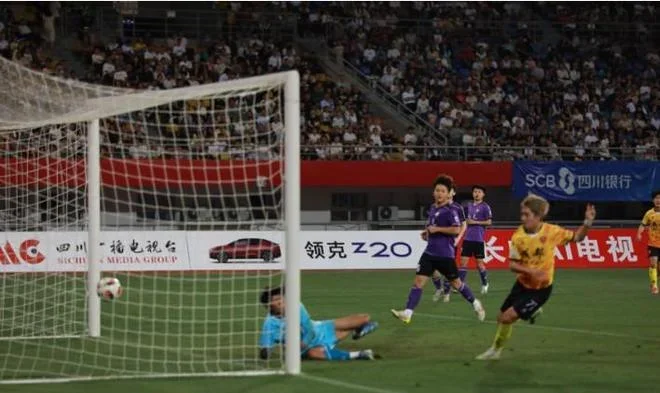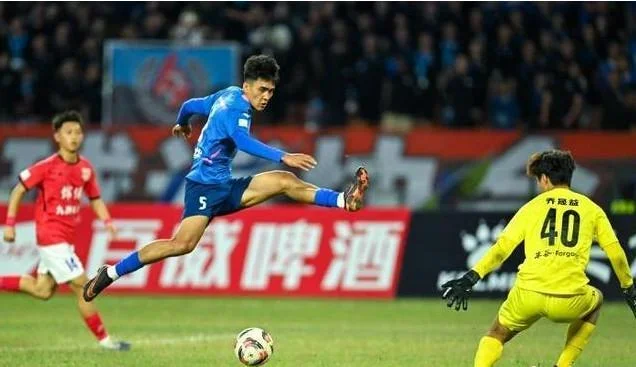
The moment arrived in the 65th minute. Du Jinyang, wearing No. 23 for Chengdu Jincheng, had just come off the bench. From 40 meters out, he struck the ball with sudden, brutal force. It flew straight, kissed the underside of the crossbar, and buried itself in the net. The commentator’s voice faltered. For half a second, even the fans were stunned. Then, the entire Shuangliu Sports Center erupted, as if the roof had been torn off.
After the match, one fan left a simple comment online: “That could make the Top 10 Goals of the Week on *World Football*.” This was May 10, the tenth round of the Sichuan Super League finals. Four matches kicked off at the same time and ended the same night. Eleven goals were scored, a bouquet of flowers was dedicated to mothers after the game, and more than a dozen stories unfolded across the pitches simultaneously.
The halfway point of the finals had arrived.
**Chengdu’s Calm Command and Nanchong’s Fifth Away Game**
A crowd of 14,263 filled Chengdu Jincheng’s home stadium, Shuangliu Sports Center. That number alone was a statement in the context of the Sichuan Super League.
Just six minutes into the match, Chengdu’s No. 55, Wu Wenjie, collected the ball, drove forward, and fired toward the far post. The linesman raised his flag for offside. But the referee, trusting his own eyes and a video review (FVS), checked the incident. The goal was allowed.
It was not a good sign for Nanchong.
No. 66, Liu Yifei, read the flow of the game perfectly. In the 20th minute, he dribbled into the box, wiggled past two defenders, and slotted the ball home. 2-0. For the entire first half, Nanchong’s goalkeeper was in top form, making at least four world-class saves—but the chaos was all in front of his net, while the silence lingered behind him.
In the second half, Liu Yifei scored again, bagging a brace. Then came the extraordinary long-range strike from Du Jinyang mentioned earlier—too far, too powerful, and too beautiful. In the 76th minute, No. 71, Dong Yuhao, added another. Chengdu was leading 5-0.
Nanchong’s No. 46, Kong Xiangnian, pulled one back in the 88th minute with a sharp shot from distance, leaving the keeper with no chance. In a way, it was the cruelest goal of the night—not because of its quality, but because it proved Nanchong never gave up, even after four consecutive away games, even with their star striker Xian Xiaolong tightly marked, even with their energy almost completely drained.
Xian Xiaolong is a name worth mentioning. He leads the league in goals with 11, the most dominant attacker of the season. But that night, he virtually disappeared into Chengdu’s defense. The home coach had clearly done his homework—shutting down the top scorer with a well-constructed defensive system was a victory in itself.
But away from the scoreline, another narrative was quietly unfolding on Mother’s Day. Before the match, Chengdu captain Liu Chao shouted in the dressing room, “Tonight, we play for our mothers—win for them.” After the game, the players transformed into tender sons, presenting bouquets of flowers to the mothers who had come to watch. Football on this night was not just football. It was a reason to say things that are usually left unsaid.
**Leshan and Mianyang: Two Stunning Goals and a Handshake Draw**
Leshan produced the first piece of magic that night. In the 13th minute, a precise long ball from the back found their forward, who raced through one-on-one with the goalkeeper. Calmly, just inside the box, he chipped the ball over the advancing keeper and into the empty net. The control and composure of that moment left Mianyang’s defenders stunned—they only realized what had happened when the ball was already nestling in the goal.
Mianyang Jiuzhou Changhong entered the match in second place on the table, having gone four matches unbeaten. They were the most consistent chasers in the title race. Leshan Weidao sat third, and their home ground had been a fortress all season.
So the 13th-minute goal was a collision of two philosophies: Leshan wanted to strike before Mianyang could settle, while Mianyang believed they could respond with even greater force. In the second half, Mianyang launched waves of attacks. In the 77th minute, the second wonder goal of the night arrived. Mianyang’s No. 36, Ou Ji, picked up the ball about 30 meters out, took a single touch, and unleashed a shot that curled with a strange trajectory, carrying the carefree spirit of “if this goes in, it’s worth it.” The ball sailed over the goalkeeper’s outstretched hand and into the net. The commentator’s silence spoke louder than any roar.
The match ended 1-1, with each team taking a point. For the title race, this result solidified Chengdu’s lead at the top—while the pack behind remained locked in a tight embrace, unable to break free from each other.
**Liangshan’s Transformation and Dazhou’s Struggle**
The 1-0 victory for Liangshan Good Doctor over Dazhou Chuan Hanzi was the quietest match of the round. But quiet is not the same as dull.
Before the match, both teams were level on nine points. Yet their situations were starkly different. Dazhou had been the surprise package of the early season, reaching the top four after seven rounds. Liangshan, meanwhile, were unpredictable—they could break Chengdu’s unbeaten run in round eight, then lose to Mianyang in round nine.
In the 26th minute, Liangshan’s No. 65, Bijichen Lin, stood over the penalty spot. He ran up, struck, and scored. Then he celebrated with a trademark somersault—a full rotation in the air that landed to the cheers of the Yi ethnic fans in the stands. Some supporters had arrived in festive clothing, and one unfurled a flag whose colors merged with the green on the pitch.
After the goal, Liangshan’s tactics shifted. They began to sit back—not in passive retreat, but in a controlled, compact defensive block. Bijichen Lin, the goalscorer, became the first line of defense. Their formation tightened like a closing fist. Goalkeeper Mousshi Shipu made three crucial saves in quick succession, each one nerve-wracking, each one successful.
This was the proof of Liangshan’s transformation—from volatile underdogs to a more disciplined side.
Dazhou, meanwhile, were mired in frustration. They created chances but couldn’t finish. At least two of their forwards broke into