

Hong Myung-bo, head coach of the South Korean national football team. Yonhap News
The South Korean national team, led by coach Hong Myung-bo, will face Mexico, Czech Republic, and South Africa in Group A of the 2026 North and Central America World Cup. While host nation Mexico appears to have a slight edge on paper, the general consensus is that there is no clear dominant force. The group is viewed as a ‘fog of war’, featuring dark horses from different continents.
South Korea’s first match is against the Czech Republic on the 12th of next month at 11 AM local time. Ranked 41st by FIFA, the Czechs secured their spot through European playoffs. The team is brimming with confidence, having ‘returned from hell’. Coach Miroslav Koubek’s side employs a similar 3-4-2-1 formation as South Korea. They focus on a solid physical defense, dropping deep to minimize goals conceded, then launching rapid counterattacks and utilizing set pieces.
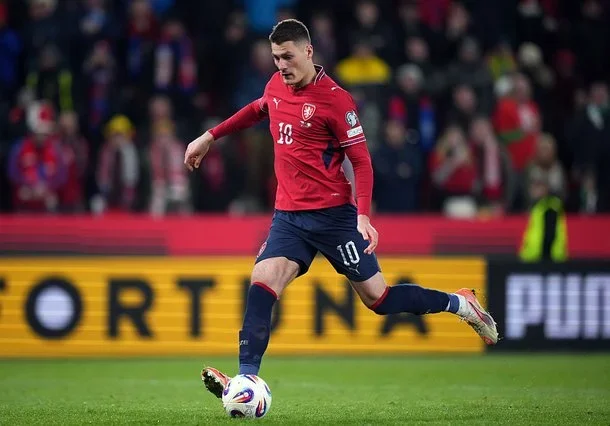
Czech striker Patrik Schick takes a left-footed shot during the World Cup European playoff against Ireland in March. Getty Images Korea
The key threat is Patrik Schick (Bayer Leverkusen), who has scored 16 goals in 27 Bundesliga matches this season. The midfield is orchestrated by West Ham’s Tomas Soucek. The Czech Republic’s strengths lie in height and organization, while their weaknesses are speed and creativity. When defensive gaps appear, they can be vulnerable to quick wing attacks. South Korea holds a slight historical disadvantage with 1 win, 2 draws, and 2 losses.
The second group match on the 19th at 10 AM is against Mexico. Ranked 15th by FIFA, the host nation aims to leverage home advantage for the top spot. Under coach Javier Aguirre, Mexico has already convened 20 domestic players since the 7th for a five-week training camp. They are enhancing organization and defensive tactics at a high-altitude camp.
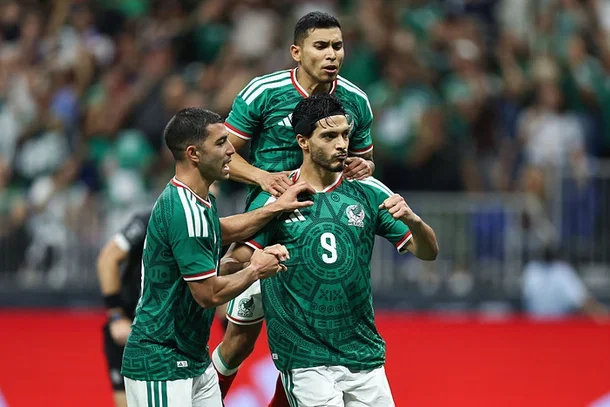
Mexico’s Raul Jimenez celebrates a goal with teammates in a match against Paraguay last November. Getty Images Korea
Aguirre employs a 4-3-3 formation that can shift to 4-4-2. They maintain a high pressing line using the altitude environment. Their tactical hallmark is rapid counter-attacks exploiting wingers’ explosive speed in transitions. The star player is Raul Jimenez (Fulham). Sports Illustrated calls him “the best player of the Aguirre era,” highlighting him as the key forward leading Mexico’s attack. He is a complete striker with aerial ability, link-up play, and finishing—the primary threat to South Korea’s defense. Edson Alvarez anchors the midfield, while veteran goalkeeper Guillermo Ochoa guards the net. Mexico leads the head-to-head record with 8 wins, 3 draws, and 4 losses from 15 meetings, including World Cup victories in 1998 and 2018.

South Africa head coach Hugo Broos. Getty Images Korea
South Korea’s final group match on the 25th at 10 AM is against South Africa, ranked 60th by FIFA—the lowest in Group A but considered a wild card. Returning to the World Cup for the first time since their 2010 hosting, South Africa has been rebuilt under coach Hugo Broos since May 2021. They use a 4-2-3-1 formation, with tight organization as their strength. Aside from striker Lyle Foster (Burnley), few players feature in top leagues. Instead, the squad is filled with domestic league players from Mamelodi Sundowns. South Africa has set up a base camp in Pachuca, Mexico, at an altitude of 2,434 meters, the highest in the group, for intense training. They aim for an upset through solid organization and local adaptation.
South Korea should learn from the past: 12 years ago, then-coach Hong Myung-bo considered Algeria a mere stepping-stone for a win at the Brazil World Cup, only to suffer a crushing 4-2 defeat. A more thorough analysis is essential for this team.
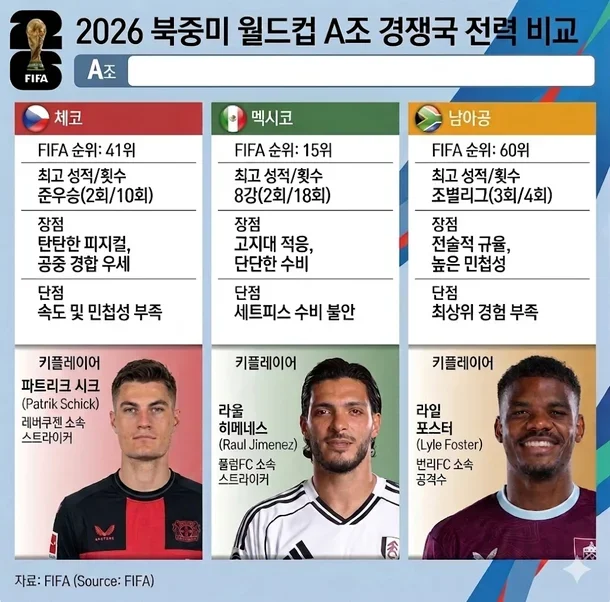
Comparison of Group A contenders for the 2026 North and Central America World Cup. AI image